Although Google Allo connected to your Google account

When Allo and Duo were announced at Google I/O, one of their pillar features was their requirement for a phone number to activate. And as most of you have noticed, this has been very controversial among users: some like the simplicity of the approach, others loathe its limitations: no multi-device support, no web/desktop clients, and a requirement for workarounds to install on tablets, especially WiFi-only ones.
With Duo's release this week, these limitations were put under the spotlight, and while some users like me were convinced by the no-fuss approach of a phone number as a means of identification, others are still moaning the lack of a tie to a Google account.
This is and is not the case with Google's other new messaging app Allo. See, while Duo doesn't really need anything more than a phone number to put you in touch with your contacts, Allo does a lot more, not least of which is the Google Assistant integration.
In order to make relevant suggestions to you, answer questions about your agenda or upcoming trips, make reservations for you, or perform searches through your email and photos, Assistant needs to know who you really are on Google, and thus Allo prefers to have more than just a phone number to go on. Otherwise, you'd have to start teaching it stuff about you from scratch and redoing that in case you changed your phone number. No bueno.
Based on information we've obtained from testers with a preview version of Allo, here's how the phone number / Google account dichotomy works.
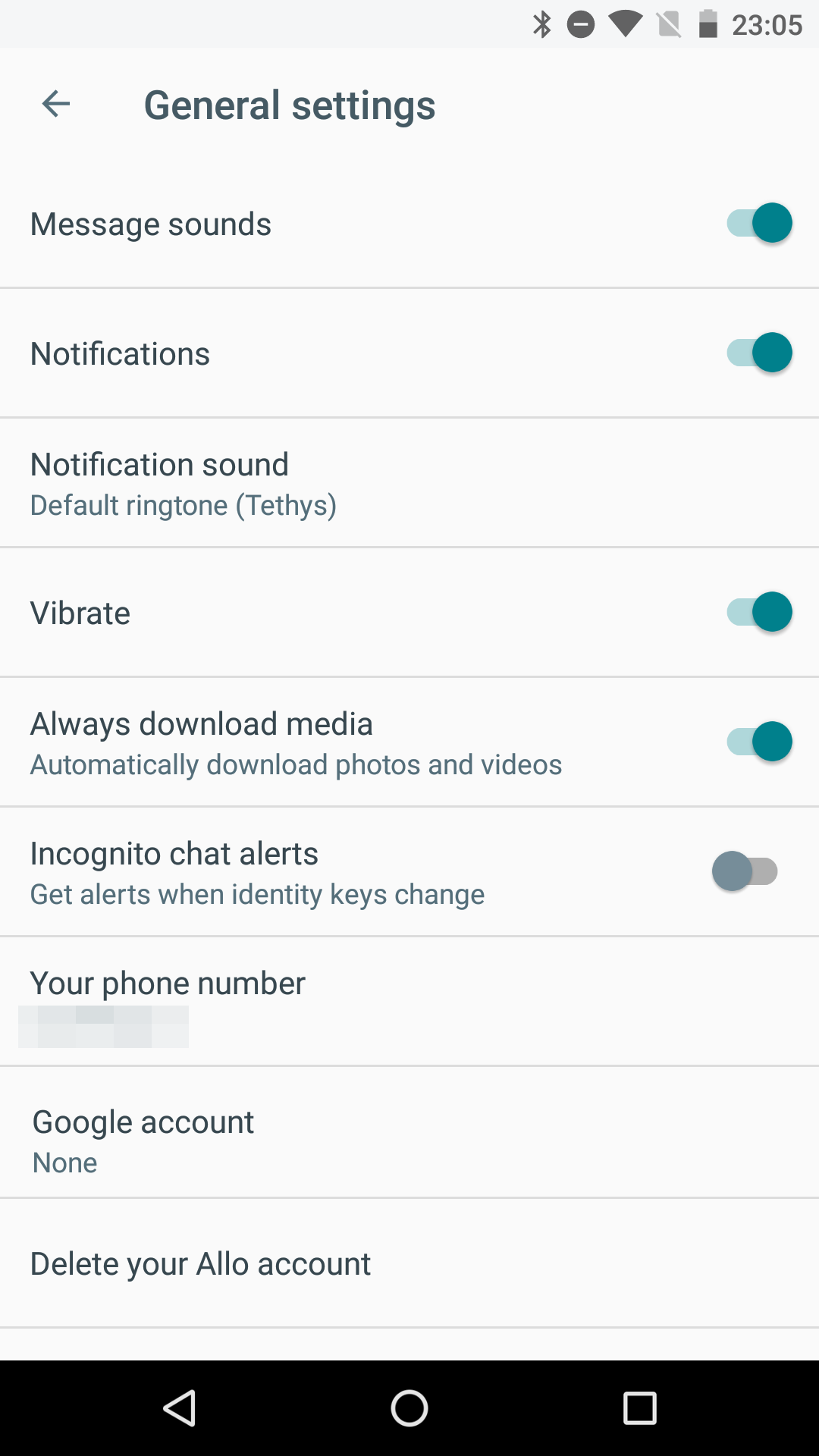
When you first install Allo, you have to activate it with a phone number and the app seems to automatically link itself to your main Google account on your device. In Allo's settings, you can see which account that is and disconnect it if you prefer to keep some distance between your Allo persona and your Google identity.
google-allo-google-account-1 google-allo-google-account-2
Once disconnected, Assistant won't be able to serve you any personal details, and will instead suggest you link a Google account... as a clingy friendly reminder, if you will. Also, by disconnecting, you open the option to choose another Google account in case you have more than one.
google-allo-google-account-4 google-allo-google-account-3
But as I said at the start, Allo is both tied and not really tied to this Google account. So far, here is what we know:
  • Your phone number is your only identifier on Allo. It's what others will use to find you, talk to you, and add you to groups.
  • Your Google account is only used to make Assistant suggestions for you.
  • Your Google account doesn't matter in any other area of the app. It is not used for backups, synced chats, or anything of the sorts.
  • Multi-device support is not available. You can have two installations of Allo on two devices tied to the same Google account, but they need to be on different phone numbers to activate in the first place. Your chats will be completely different on these two devices (again, because tied to phone number).
This is where things stand in the preview version of Allo. They may be different in the final release, or they may not. Odds are, if you ask me, they'll stay like this.
But the optimist in me sees hope in the Google account integration in Allo. Since the app doesn't offer end-to-end encryption by default, it might be possible for Google to implement a link based on your Google account between different devices and thus sync your regular chats, do backups and restores, and allo-w (sorry) you to chat from more than just one phone, even if your identifier remains your phone number. Incognito chats, however, would have to be tied to one device to stay encrypted. (Come to think of it, that's how Facebook Messenger works, isn't it?) But that's just me speculating...

First look Google Pixel and Pixel XL hands-on

Introduction

Android is by far the most popular smartphone OS - 7 out every 8 phones run some version of it. And yet its purest form, a Nexus device, is anything but dominant in the marketplace. A rebranding effort sees the "Google phones" change the name to Pixel in the hope to change the popularity as well.
The Pixel and Pixel XL maintain the 0.5" difference in screen size, but drop to 5" and 5.5" respectively. Aside from screen size and the battery, the two metal body phones have virtually the same hardware.
Google Pixel keynote Google Pixel keynote Google Pixel keynote
Google Pixel keynote
Both now use AMOLED screens - this is a requirement for Daydream VR, they can change pixels faster with minimal ghosting. The screen has to have at least 1080p resolution, further the phone needs 4GB (or more) of RAM and run Android Nougat. This is essentially the 5" Google Pixel.

Google Pixel at a glance:

  • Body: Metal unibody
  • Screen: 5" 1080p AMOLED screen (441ppi); Gorilla Glass 4
  • OS: Android 7.1 Nougat; Android Assistant
  • Chipset: Snapdragon 821
  • Memory: 4GB of RAM; 32GB or 128GB storage
  • Camera: 12MP (f/2.0, 1.55µm); EIS, 8MP selfie camera
  • Video: 2160p
  • Connectivity: LTE (Cat. 9-12); Wi-Fi calling; USB Type-C
  • Battery: 2,770mAh (32h talk time, 552h standby); Fast charging (7h talk time in 15min)
  • Misc: Fingerprint reader
The larger Pixel XL goes up to QHD resolution and a higher pixel density. It has the same amount of RAM and storage options, though - 32GB or 128GB. Before you ask, there's no microSD slot, but Google Photos can free up storage by moving photos and videos to the cloud.

The LG V20 may have been the first phone with Android 7.0 Nougat out of the box, but the Pixels one up it - literally, they come with 7.1 Nougat. Google Assistant is Google Now's more talkative, more pro-active sibling. It promises to learn the more you use it and become more helpful in time.

Google Pixel XL at a glance:

  • Body: Metal unibody
  • Screen: 5.5" QHD AMOLED screen (534ppi); Gorilla Glass 4
  • OS: Android 7.1 Nougat; Android Assistant
  • Chipset: Snapdragon 821
  • Memory: 4GB of RAM; 32GB or 128GB storage
  • Camera: 12MP (f/2.0, 1.55µm); EIS, 8MP selfie camera
  • Video: 2160p
  • Connectivity: LTE (Cat. 9-12); Wi-Fi calling; USB Type-C
  • Battery: 3,450mAh (26h talk time, 456h standby); Fast charging (7h talk time in 15min)
  • Misc: Fingerprint reader
The cameras use 12MP sensors with 1.55µm pixels behind an f/2.0 aperture - it sounds just like the Nexus 5X/6P camera, which was excellent. It's not a verbatim copy, new Electronic Image Stabilization is present.
The talk around town is that Android and Chrome OS will merge in the near future, but product branding is already merging - Pixel was used for the premium Chromebooks and later for a first-class Android tablet. However, this is the first time it embodies a phone.
HTC is the company manufacturing the Pixel and Pixel XL - a 5" and a 5.5" version of mostly the same hardware. The Taiwanese company is going back to its roots of an ODM - a Pixel is a "Phone by Google", there's no endorsement of HTC's involvement. Google is about hardware now and it's only braning we'll see from now on on these devices.
This stands in stark contrast to the Nexus line - they were branded "Nexus" and with their manufacturer's logo. But the Pixel phones are not the new Nexus phones - Google is rebooting the entire lineup. The search engine company is no longer a software company - it's now in the consumer electronics business as well.
Google Pixel and Pixel XL hands-on
The Pixel and Pixel XL are the children of Google's new hardware division and this is a key selling point.
And they can connect to a Google Wi-Fi router, interact with the Google Chromecast Plus and other devices in the fast-growing eco-system of G-branded products. But as phone buffs, we jumped on the Pixels first.

First look Asus Zenfone 3 ZE552KL preview

Introduction

Asus has been making phones for a few years now but the company hadn't quite managed to leave a mark on the market and the consumers' mind. That changed a bit with last year's ZenFone 2 series that offered unheard of specs at incredible prices, which made them quite popular among the budget conscious users.
Asus Zenfone 3 ZE552KL preview
This year the ZenFone 3 series is a bit different. Asus seems to have no interest to appeal to the budget market and is going straight for the flagship segment.
The first phone in the series to be launched is the simple-named ZenFone 3. Okay, calling it 'simple-named' downplays the fact that there are in fact two distinct model names - theZE552KL and the ZE520KL - and that's without counting the extra Zenfone 3 phones in the family - MaxDeluxeLaser, and Ultra. Confused enough? Well, don't be, these models will likely never be available on a single market simultaneously, so it's only websites that cater to several regions that need to make sense out of it.
Today we're previewing the Asus Zenfone 3 ZE552KL to be more precise. It's got a bigger screen, more memory and storage, and larger battery than its similarly named sibling and yet, with a price around $300-350, it costs less than the other Zenfone 3 phones.
Here's a brief version of the complete specs list before we continue.

Asus Zenfone 3 ZE552KL at a glance:

  • 5.5-inch, 1920x1080 IPS LCD
  • Qualcomm Snapdragon 625; 2.0GHz octa-core Cortex-A53 CPU, Adreno 506 GPU
  • 4GB RAM, 64GB storage with microSD expansion
  • Dual SIM support (hybrid slot)
  • 4G LTE, VoLTE, Wi-Fi ac, Bluetooth 4.2, GPS/GLONASS/BeiDou , USB Type-C 2.0
  • 16 megapixel rear camera, f/2.0, laser/PDAF, OIS+EIS, 4K video, dual LED flash
  • 8 megapixel front camera, f/2.0
  • Rear-mounted fingerprint reader
  • 3000mAh battery
  • Android 6.0.1 with Asus ZenUI 3.0
We spent a few days with the new ZenFone 3 to get a feel of how Asus's smartphone lineup is looking this year so join us on the next page for our impressions. Spoiler alert: It's looking pretty good.

Life of a Star Huawei nova review

Introduction

Look, it's the Nexus 6P! But smaller. Well, not really - it's the Huawei nova. It's a star in the making, and you can find it in the mid-range cluster of the company's mobile universe. The nova takes after the flagship-grade Nexus 6P, which unsurprisingly, is also Huawei-made.
The Huawei nova is a new take on the mid-range smartphones introducing a pinch of premium feel over the mandatory hardware minimum. And Huawei has never been about just ticking a few boxes; instead, they always strive to find a way to add a twist here and there for a richer user experience.
Huawei nova review
Indeed, the nova is as stunning as the P9 because both share similar looks, but its 1080p IPS display has been trimmed down to just 5". The chipset has been swapped with the energy-efficient Snapdragon 625, which is an excellent choice for the class and a wise decision for an optimal battery performance.
Finally, there is a single 12MP camera on the back, which may be single and without the Leica branding, but it's as promising, at least on paper. Before we continue, check the full specs of the Huawei nova.

Huawei nova key features

  • 5" IPS LCD display of 1920x1080 pixels resolution, 441ppi
  • Full metal unibody design out of airplane-grade aluminum
  • Qualcomm Snapdragon 625 chipset, octa-core 2.0GHz Cortex-A53 CPU; Adreno 506 GPU
  • 3GB of RAM, 32GB storage
  • Android 6.0.1 Marshmallow with Emotion UI 4.1
  • 12MP camera with a LED flash, f/2.0 aperture, hybrid autofocus, PDAF+ contrast detection; 4K video recording
  • 8MP front-facing camera with f/2.0 aperture, 1080p video
  • 3,020mAh Li-Po battery with rapid charging (35% in 30 minutes)
  • Hybrid DualSIM/microSD card slot (up to 128GB)
  • Cat. 7 LTE (300/150Mbps); dual-band Wi-Fi b/g/n, Wi-Fi hotspot, Wi-Fi Direct; Bluetooth 4.1 LE; NFC; GPS/GLONASS; FM radio; USB Type-C
  • Available in Prestige Gold, Titanium Gray and Moonlight Silver

Main disadvantages

  • No scratch-resistant screen coating
  • Non-removable battery
  • Hybrid DualSIM/microSD card slot limits options on the dual-SIM model
  • Only single-band Wi-Fi support
  • A bit pricey
The lack of any information on the screen protection is as disturbing as it was a few Huawei smartphones ago. We have already confirmed that a few of Huawei's latest displays are easy to scratch, and that's probably the nova case, too. And it's beyond us why the Huawei nova lacks dual-band Wi-Fi support as the chipset natively supports it.
Huawei nova review
The sooner we let go of those two omissions, the sooner we'll jump onto our traditional hardware checkup.


Copyright @ 2016