HTC One E9+ review

If you want HTC's highest-specced, big-screened QHD smartphone, the One E9+ is very likely the one you're looking for. Only the lack of the signature all-metal unibody saves the company's reigning flagship a good deal of embarrassment.
HTC One E9+
It's quite hard to actually decide which precise model sits atop HTC's 2015 One lineup, and there may well be more than one correct answer. You have the M9, obviously, which has Qualcomm's latest chipset inside and the metal design to appeal to your sense of style, but sticks with a FullHD 5-inch screen.
Midway up the size ladder, you'll find the 5.2-inch QHD M9+, which retains the metal unibody and adds a second camera on the back, as well as a fingerprint sensor, but opts for an arguably inferior Mediatek chipset. There's an almost identical ME version, which comes with a single rear camera, and comes with a polycarbonate body.
All that builds up to the HTC One E9+, which has finally landed in our hands. It has the largest 5.5-inch QHD screen of the bunch (so, not to be confused with the E9, which is apparently a China-only 1080p 5.5-incher), a slightly downclocked version of the same Mediatek chipset and a polycarbonate build.
With the family relations (somewhat) settled, let's move on to the list of key specs.

Key features:

  • Polycarbonate body, soft matte finish, thin and light for its size
  • 5.5" 1440p capacitive touchscreen with 534pi; Corning Gorilla Glass 4
  • Mediatek MT6795M (Helio X10) chipset with a 2GHz octa-core Cortex-A53 CPU, PowerVR G6200 GPU, 3GB of RAM
  • Android 5.0.2 Lollipop with HTC Sense 7 UI
  • Wi-Fi 802.11 a/b/g/n/ac (2.4 & 5 GHz); DLNA, WiFi direct, hotspot
  • 20MP AF camera with a 1/2.3" BSI sensor; 27.8mm f/2.2 lens; single-LED flash; 2160p@30fps video capture, 720p@120fps slow motion
  • 4MP fixed-focus UltraPixel front-facing camera with a BSI sensor; 26.2mm f/2.0 lens; HDR; 1080p video recording
  • 32GB of built-in memory; microSD card slot; 100GB of free Google Drive storage for 2 years
  • Dual nanoSIM slots, LTE Cat.4, GPS/GLONASS/Beidou, NFC, Bluetooth 4.1, FM radio; microUSB 2.0 port, MHL, USB host
  • Active noise cancellation with a dedicated microphone
  • Front-facing stereo speakers with BoomSound and Dolby Audio
  • 2,800mAh battery

Main disadvantages

  • Tall for a 5.5-inch phone, massive top and bottom bezels
  • Non-removable battery
  • Chipset looks more suited to a mid-ranger
You can see why one might get confused. The HTC One E9+ has all the makings of a modern day high-end device, albeit in a rather understated package. And it's not like HTC hasn't done it before, last generation's E8 was just that - a flagship in disguise. Only, now HTC is giving you even more options and it's not a simple price-vs-looks dilemma.
HTC One E9+ HTC One E9+ HTC One E9+ HTC One E9+ 
HTC One E9+ press images
It is, however, the first time we get to see the Mediatek MT6795 in action (also going by the PR-friendly Helio X10). It's an interesting decision by HTC part to equip all its QHD smartphones so far with the Mediatek top-of-the-line solution and reserve the Snapdragon 810 for the FullHD One M9.

The triathlete Samsung Galaxy S6 Active review

Once again its June and time for Samsung to present us with a rugged version of its latest range-topping smartphone. This year, once more exclusively for AT&T, it is Samsung Galaxy S6 Active that enters the spotlight with camouflage livery, gobs of tech, and tough build.
For a second year in a row, Samsung has made sure that the Galaxy S6 Active is not simply a rugged version of the incumbent flagship by adding unique features to it. Last year, the Korean giant added a customizable shortcut button for quick access to an Activity app.
This year, in addition to the above feature, Samsung Galaxy S6 Active also packs a massive 3,500mAh battery. The latter is roughly 40% larger than the 2,550mAh unit found in the regular model and promises to be a boon for the device's target audience.

Key features

  • MIL-STD-810G certification for salt, dust, humidity, rain, vibration, solar radiation, transport and thermal shock resistance
  • IP68 certification for dust and water resistance (submersible up to 1.5 m of water for up to 30 minutes)
  • 5.1" Super AMOLED of QHD (1440 x 2560) resolution, class-leading ~577ppi, Corning Gorilla Glass 4
  • Exynos 7420 64-bit chipset, octa-core processor with four 2.1GHz Cortex-A57's and four 1.5GHz Cortex-A53 cores, Mali-T760 MP8 GPU, 3GB of RAM
  • Android 5.0.2 Lollipop with TouchWiz UX
  • 16MP camera, f/1.9 aperture, 4K video recording, LED flash, optical image stabilization
  • 5MP front-facing camera, f/1.9 aperture, QHD video, HDR
  • 32GB of built-in UFS 2.0 storage
  • Active noise cancellation via dedicated mic
  • Customizable shortcut button
  • LTE Cat.6, Wi-Fi a/b/g/n/ac, GPS/GLONASS/Beidou, NFC, IR port, Bluetooth 4.1, ANT+
  • Heart-rate sensor, barometer, SpO2
  • 3,500mAh battery; wireless charging (Qi/PMA)
  • No price premium over the regular model (on AT&T)

Main disadvantages

  • Available with only 32GB of onboard memory
  • No microSD card slot
  • Battery is not user-replaceable
  • No stereo speakers
  • No fingerprint sensor
  • Available only for AT&T (at least for now)
  • Gobs of carrier bloatware preinstalled
  • Not exactly a looker
As you can see above, Samsung Galaxy S6 Active is the same technological powerhouse as its regular sibling, but with with added water, shock and dust resistance. After a quick glance, some might even argue that the newcomer is the pick in the Galaxy S6 range thanks to its aforementioned quality and the massive 3,500mAh battery.
Limited availability and memory capacity are the handset's biggest drawbacks at a quick glance, though Samsung might remedy both should it decide to launch an global variant of the device. The lack of fingerprint sensor is arguably another downer, though the target audience for the Samsung Galaxy S6 Active will likely appreciate the sturdier navigation buttons better.
Samsung Galaxy S6 Active Samsung Galaxy S6 Active Samsung Galaxy S6 Active 
Samsung Galaxy S6 Active official photos
As always, we are going to kick the review off with unboxing, followed by our take on the design and build. Head over to the next page for a closer look at the Samsung S6 Active and its camouflage outfit.

Nokia N1 review

Microsoft's acquisition of Nokia's Devices & Services division was one of the toughest tech breakups. Nokia has sort of a comeback to consumer devices though by licensing their brand for Foxconn to use in a co-designed product - the Nokia N1 tablet. It runs Android and has an all-aluminum body, plus it's among the first devices with USB Type-C, which shows the Nokia team hasn't lost its drive to innovate.
Nokia N1
This isn't quite the old Nokia though, all the engineering talent for mobile devices went over to Microsoft. Still, Nokia oversaw the design while Foxconn (better known in the West for manufacturing stuff for Apple) will do the actual building.
Speaking of Apple, the Nokia N1 is very clearly positioned as an Android alternative to the iPad mini. It's not the first, but at least it nails the aluminum unibody. Other similarities include the 7.9" screen with 4:3 aspect ratio and the reversible plug.
While it may have borrowed the form factor, Nokia beat its own path with a customized Android. The result is a mish-mash of Android styles ranging from Gingerbread (seriously) to Lollipop. The base OS is Android 5.0 Lollipop, but Nokia's custom apps need work.

Key features

  • Aluminum unibody, 6.9mm thick
  • 7.9" IPS LCD, 1,536 x 2,048 pixels, 324ppi; Gorilla Glass 3
  • Android 5.0 Lollipop with Z Launcher
  • Intel Atom Z3580 chipset with 2.3 GHz quad-core processor, PowerVR G6430 GPU, 2GB of RAM
  • 8MP camera, LED flash, 1080p video recording
  • 5MP front-facing camera with 1080p video recording
  • 32GB of built-in storage, no memory card slot
  • USB Type-C connector (a first in a tablet)
  • Wi-Fi a/b/g/n/ac, Bluetooth 4.0 with A2DP
  • Stereo speakers (x 0.5W); Wolfson WM8958E codec
  • 5,300mAh battery

Main disadvantages

  • Software feels unpolished
  • No built-in 3G option
  • No GPS
  • No memory expansion, no higher capacity options
  • Type-C connector works at USB 2.0 level only
Note that we got our Nokia N1 unit brought from China so it doesn't have Play Store installed, but the international version, which is reportedly under way, will have proper access to Googles' store. Nokia's app store is obviously not up to par.
The one piece of software that is actually good is the Z Launcher. It simplifies launching apps by using handwriting recognition - you scribble a letter or two to search for an app. The launcher will learn which apps you use the most and offer them on the homescreen. If that sounds cool, you can try it out on any Android device by downloading the Z Launcher from the Play Store.
Nokia N1 Nokia N1 Nokia N1 Nokia N1 
Nokia N1 official images
The Nokia is at the forefront of the inevitable move to the superior USB Type-C. The company also played it safe with the choice of chipset, going with Intel instead of troubled Qualcomm - the Atom Z3580 will age better than the Snapdragon 810 if you ask us.
Nokia's return to consumer products brings a mix of excitement and disappointment, but we certainly hope we'll even more products from the Nokia/Foxconn partnership - why not even phones.

HTC's upcoming Desire 10 Lifestyle

Evan Blass (@evleaks), who was supposed to have retired a little over two years ago, is still one of the best in the leaking game. His latest reveals, the HTC Desire 10 Lifestyle and Desire 10 Pro, are a bit strange in that while the Pro model is pictured, it's the Lifestyle model that is detailed thoroughly. Blass says that his source is someone who was briefed on HTC's plans, so the information should be fairly reliable.
VentureBeat (where Evan is a writer) is reporting that the Desire 10 Lifestyle will feature a 5.5-inch 720p display, an unknown Qualcomm Snapdragon SoC, and Android 6.0 Marshmallow with HTC Sense. The main camera is a 13MP BSI sensor with a single LED flash, while the front-facing one is a 5MP sensor that is also BSI-equipped. Both cameras are capable of 1080p video. The Desire 10 Lifestyle will also feature "Boomsound Hi-Fi Edition" stereo speakers with 24-bit audio pumping through both the speakers and headphone jack.
The Desire 10 Lifestyle will be available in configurations of 3GB RAM/32GB storage and 2GB RAM/16GB storage. It will come in several colors, all of which will be blinged-out with lots of gold trim. A pair of high quality earphones will come in the box.
desireprowhite
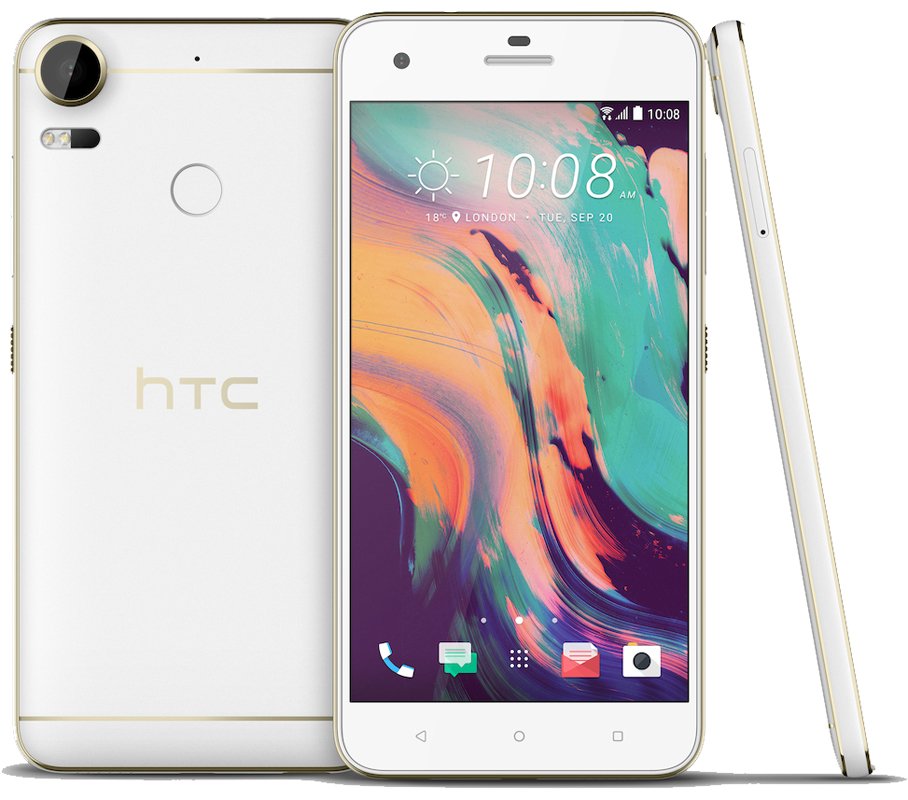
Desire 10 Pro in white.
Moving on to the Desire 10 Pro, this more upmarket device will likely incorporate similar design elements to its Lifestyle brother, if not reuse the entire shell. From pictures of the Pro model, we can see that the gold trim first mentioned for the Lifestyle is prevalent here, as is a single-LED equipped camera. There appear to be chamfers on both the front and rear, although nowhere near as severe as the flagship 10's rear chamfer. The camera protrudes a decent bit here. There is a circular fingerprint sensor on the back and capacitive keys up front. We can also peep a ridged power button (always a nice touch) with volume buttons above it and what appears to be laser autofocus next to the flash.
If we dig even deeper, we can see that the date on the clock widget is September 20th. This not only corroborates VentureBeat's suspicion that the Desire 10 Lifestyle will launch in late September, but also a tweet of @evleaks's saying that the Desire 10 will arrive at the end of Q3. HTC has been known to leave little hints of expected launch days in renders, so we're not just grasping at straws here.
Unfortunately, we don't have any information regarding how much both phones will cost.


Copyright @ 2016