HTC's upcoming Desire 10 Lifestyle

Evan Blass (@evleaks), who was supposed to have retired a little over two years ago, is still one of the best in the leaking game. His latest reveals, the HTC Desire 10 Lifestyle and Desire 10 Pro, are a bit strange in that while the Pro model is pictured, it's the Lifestyle model that is detailed thoroughly. Blass says that his source is someone who was briefed on HTC's plans, so the information should be fairly reliable.
VentureBeat (where Evan is a writer) is reporting that the Desire 10 Lifestyle will feature a 5.5-inch 720p display, an unknown Qualcomm Snapdragon SoC, and Android 6.0 Marshmallow with HTC Sense. The main camera is a 13MP BSI sensor with a single LED flash, while the front-facing one is a 5MP sensor that is also BSI-equipped. Both cameras are capable of 1080p video. The Desire 10 Lifestyle will also feature "Boomsound Hi-Fi Edition" stereo speakers with 24-bit audio pumping through both the speakers and headphone jack.
The Desire 10 Lifestyle will be available in configurations of 3GB RAM/32GB storage and 2GB RAM/16GB storage. It will come in several colors, all of which will be blinged-out with lots of gold trim. A pair of high quality earphones will come in the box.
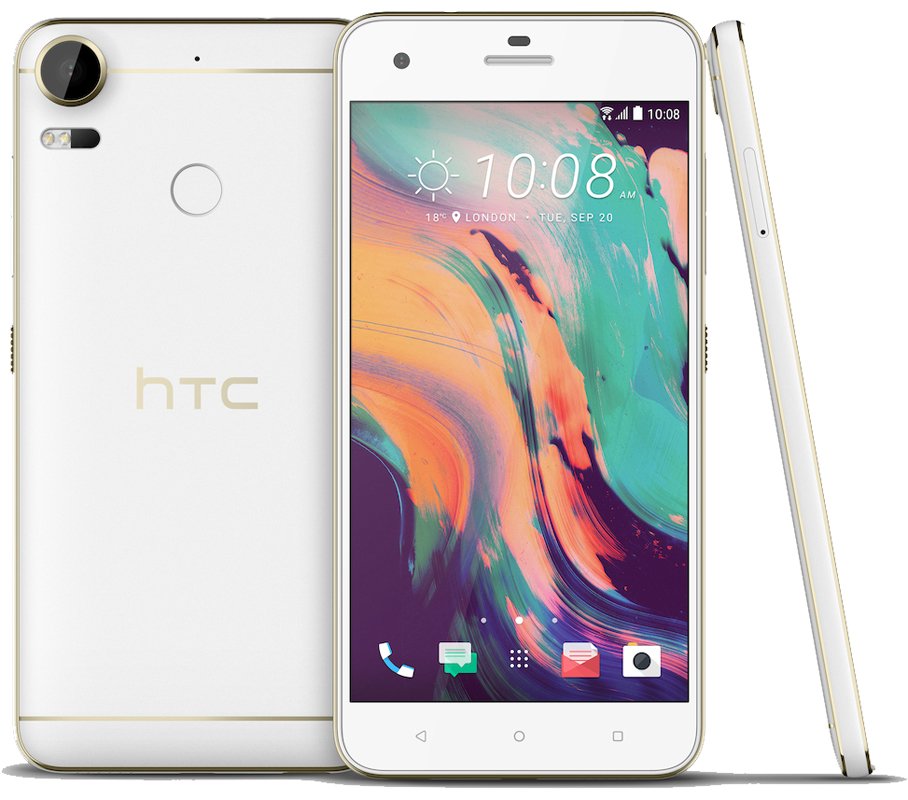
desireprowhite
Desire 10 Pro in white.
Moving on to the Desire 10 Pro, this more upmarket device will likely incorporate similar design elements to its Lifestyle brother, if not reuse the entire shell. From pictures of the Pro model, we can see that the gold trim first mentioned for the Lifestyle is prevalent here, as is a single-LED equipped camera. There appear to be chamfers on both the front and rear, although nowhere near as severe as the flagship 10's rear chamfer. The camera protrudes a decent bit here. There is a circular fingerprint sensor on the back and capacitive keys up front. We can also peep a ridged power button (always a nice touch) with volume buttons above it and what appears to be laser autofocus next to the flash.
If we dig even deeper, we can see that the date on the clock widget is September 20th. This not only corroborates VentureBeat's suspicion that the Desire 10 Lifestyle will launch in late September, but also a tweet of @evleaks's saying that the Desire 10 will arrive at the end of Q3. HTC has been known to leave little hints of expected launch days in renders, so we're not just grasping at straws here.
Unfortunately, we don't have any information regarding how much both phones will cost.

LG G4 vs. Samsung Galaxy S6

Sometimes the biggest rivalries are between neighbors. The newest additions to clan LG and clan Samsung are from two different worlds - the organic LG G4 and the industrial Galaxy S6. One is curved with soft leather, the other is a cool glass and metal sliver.
LG G4 vs. Galaxy S6
Samsung had a misstep with the S5 so it had to reboot the design for the Galaxy S6. Meanwhile LG G4 is an evolution from its well-received predecessor. Both flagships took steps towards a luxury design though they are on very different paths.
The LG G4 opted for premium leather and a slightly curved design (to stand apart from the Moto X). Samsung took the popular route and designed a slender metal frame sandwiched between two panes of glass.

LG G4 over Galaxy S6

  • Larger screen - 5.5" vs. 5.1"
  • Higher res selfies - 8MP vs. 5MP
  • Expandable storage
  • Removable battery
  • microUSB SlimPort and FM radio
  • Laser autofocus and Color spectrum sensor
  • Optional leather back

Samsung Galaxy S6 over LG G4

  • More compact, much thinner
  • Faster chipset - more CPU cores and better GPU
  • Sharper screen with better sunlight legibility
  • Better battery life
  • Fingerprint sensor
  • Metal construction
  • Heart rate and blood-oxygen (SpO2) sensor
  • Wireless charging - Qi and PMA (may not be available in some regions)
Consumer sentiment is highly important in this business and this time it seems like it's on LG's side. Users stuck with homely Galaxys because they were practical - light durable plastic, user-serviceable storage and battery. The Galaxy S6 design while beautiful introduced more glass that might get scratched and worse, it locked up the back panel.
There were plenty of furrowed faces when battery and storage access was taken away so LG scored brownie points with the G4 that gives you full access to both. It has some longevity worries of its own though, Moto X's leather backs age pretty badly. It will be months before we know if the G4 will suffer the same fate, but at least you can always change the back with a fresh one. Not so with a scuffed Moto X or a scratched Galaxy S6.
LG G4 vs. Galaxy S6 LG G4 vs. Galaxy S6 LG G4 vs. Galaxy S6 LG G4 vs. Galaxy S6 
LG G4 and Samsung Galaxy S6 square off
An overview of the two phones quickly reveals the points of contention. The LG comes with the bigger screen, but Samsung has perfected Super AMOLED. The G4 has unique camera features and a retooled camera software. The Galaxy S6 focused on getting the fingerprint sensor right and improving the health-tracking hardware.
The Samsung also has the upper hand in processing muscle, thanks to Samsung's semiconductor fabs, while LG had to work around Qualcomm's difficult transition to next-gen processors.

Kickstarted Pebble Time review

Almost three years after its predecessor took Kickstarter by storm, the Pebble Time crashes the smartwatch scene with an even louder bang. The newcomer became the most successful Kickstarter project to date only a few days after its launch and ended up with more than $20 million in funding.
Of course, three years is a hell of a long time in the tech industry, and the Pebble Time arrives in a totally different landscape compared to its trailblazing predecessor. An Apple Watch backed by a monstrous marketing budget and an army of Android Wear devices are as serious a competition to face as it gets.
To face its competitors, the Pebble Time comes with a color screen, voice control, and a brand new OS. It is also the most water-resistant smartwatch available at the moment. See the device's full list of key features below.

Key features

  • 1.25" 64-color LCD e-paper display with memory-in-pixel technology and LED backlight; 168 x 144 pixels (182ppi); curved Gorilla Glass 3; superb sunlight legibility and power efficiency;
  • ARM Cortex-M4 CPU; 256KB of RAM; 16MB of storage
  • 3D accelerometer; compass; ambient light sensor
  • Built-in microphone for voice replies
  • Pebble OS with support for actionable notifications (Android only)
  • Samsung-made 150mAh battery, a week worth of battery life
  • Bluetooth 4.0 connectivity
  • 40.5 x 37.5 x 9.5mm; 42.5 grams with standard silicone band easily replaceable, standard 22mm band
  • 30m water resistance

Main disadvantages

  • The display lags behind the competition in terms of colors, resolution, and performance indoors
  • iOS device functionality lags behind the one for Android
  • Limited app ecosystem (at least for the time being)
  • Plasticky construction, though there is a Pebble Time Steel on the way
With a color screen and more capable hardware, the Pebble Time is unsurprisingly a massive upgrade over the first generation. The new model has also retained the key features that made the original Pebble such a success, headed by mind-blowing battery life and ease of use.
Despite being an update over its predecessor in terms of design and hardware however, the Pebble Time lags behind the Apple Watch and the Android Wear army on this instance. Competing smartwatches from Apple and Google look more stylish and boast better screens, internals, and app ecosystems, thus meaning that the Time will have to rely on ease of use and battery life to gain followers.


Copyright @ 2016